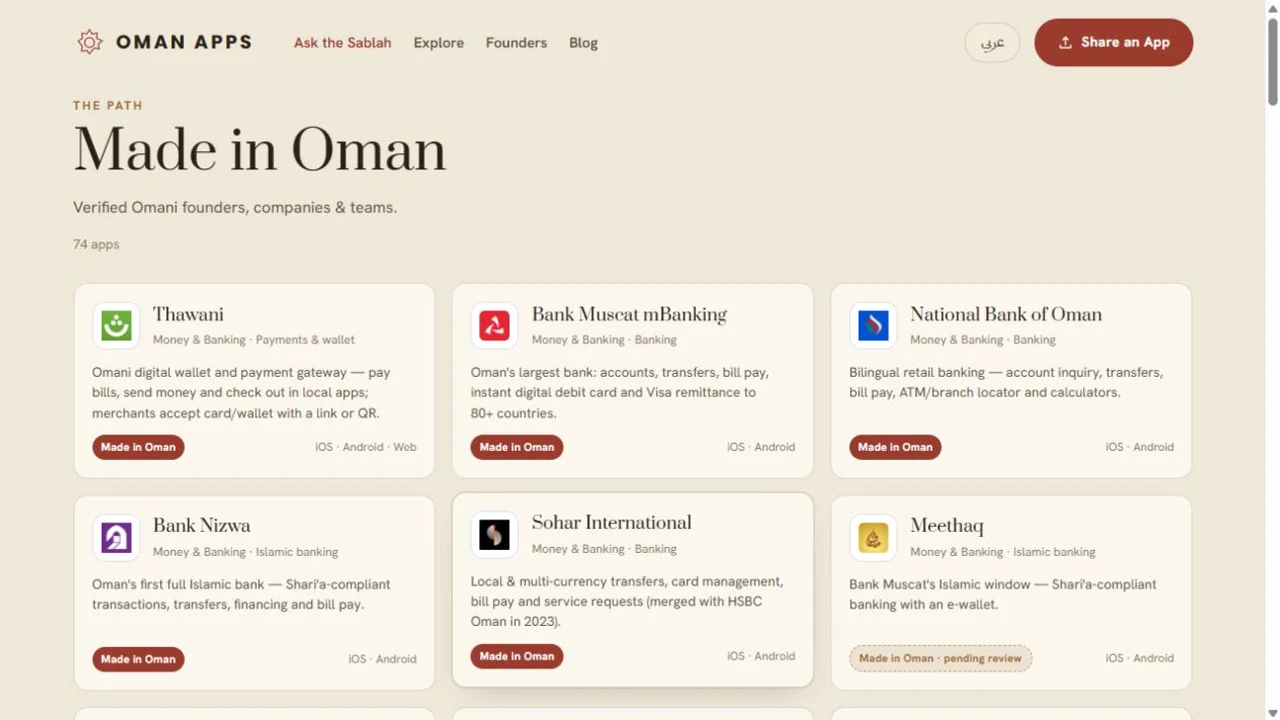
Apps in Oman is my live bilingual directory project. It starts with a distinction that is easy to lose in a long list of apps: being made in Oman and being available in Oman are different things. The site gives those relationships separate browsing paths, so a visitor can start with the question they actually have.
Organise around the visitor’s question
The directory offers paths for apps made in Oman, apps that work in Oman, and apps useful to visitors. The homepage also provides audience entry points and a search interface. These are different ways into the same subject, rather than a single list everyone must interpret.
A founder looking at the local ecosystem and someone settling into the country may need different information. Good information architecture makes room for those differences. For a business website, the equivalent is grouping services around what customers are trying to accomplish.
Make the meaning of a label explicit
A country label can imply ownership, location, availability or relevance. The directory separates these ideas. Its published verification method describes looking for ownership evidence for local origin and practical service coverage for local availability.
This is an important distinction in directory design: a badge should have a meaning someone can explain. The site publishes that method so the labels have context. An attractive card alone cannot tell a visitor how reliable its information is.
Show uncertainty and leave room for corrections
The verification approach treats unreviewed information as a starting point for research. It describes confidence levels, review dates and ways to suggest corrections. A listing awaiting review should be understood as such, rather than as a confirmed claim.
Maintaining a directory is ongoing work. Apps change, services stop operating and ownership information can become outdated. A useful product therefore needs a correction process as well as an initial collection of entries. The published method describes that process; it is not a guarantee that every entry remains current.
Bring the structure into both languages
The live site provides Arabic and English navigation and corresponding browsing pages. Bilingual work involves the page structure, reading direction, labels and links as well as the words in a paragraph. A person should be able to understand where they are in either version.
This project brings together a searchable content structure, visual presentation and a published approach to trust. For a customer planning a directory or content-led website, those are useful questions to address early: what belongs in a listing, how people find it, and how it stays accurate.
Common questions
Is Apps in Oman live?
Yes. You can explore the directory at appsinoman.com using the links below.
Does every entry have the same verification status?
No. Read the status and evidence associated with an entry, and use the published verification method to understand the distinctions.